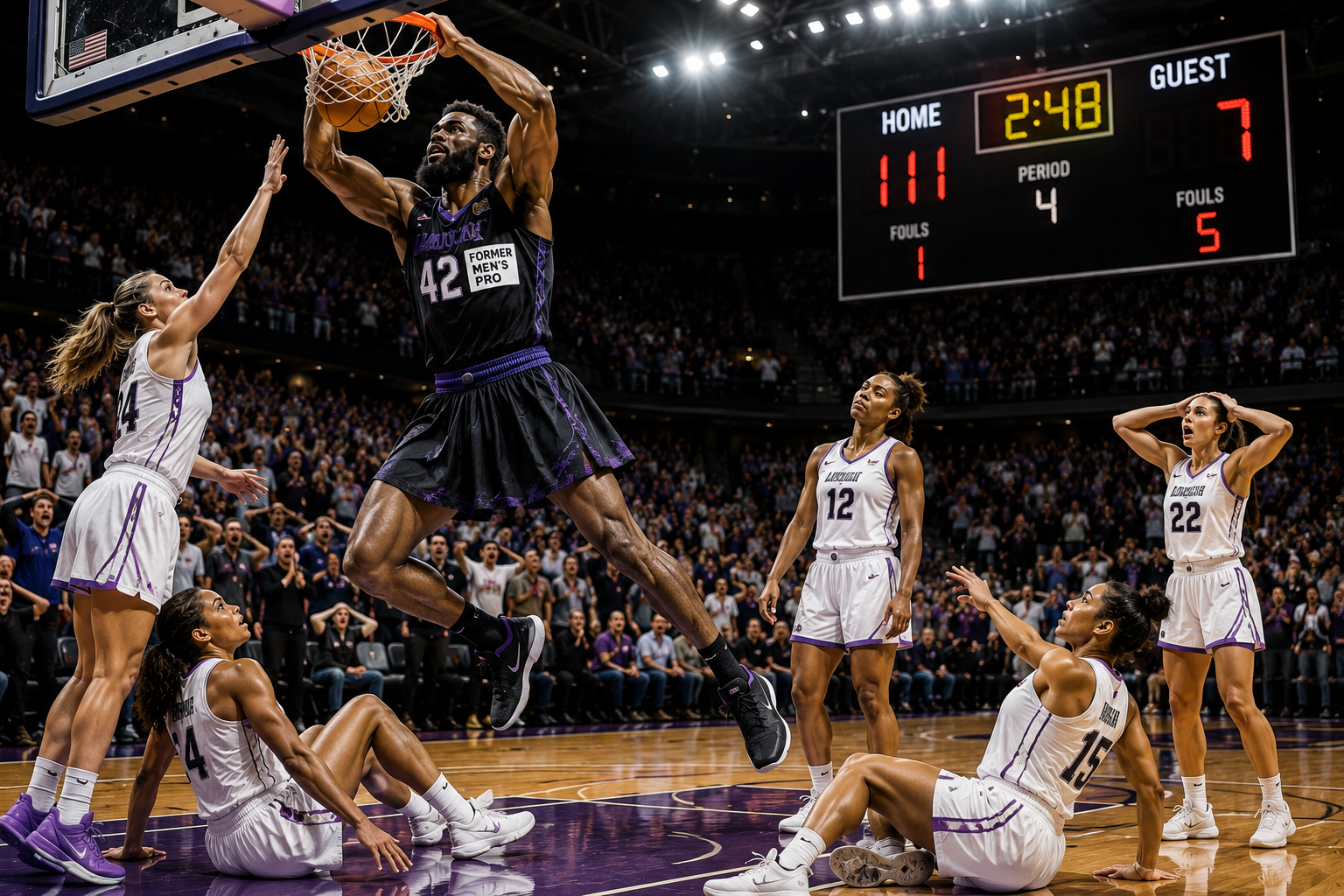
Welcome to the WMBA.
No, that isn’t a typo. Let me explain.
If the Women’s National Basketball Association (WNBA) ultimately decides that biological males may qualify for its teams simply by pretending they are women, then perhaps intellectual honesty requires changing the name. The Women’s and Men’s Basketball Association (WMBA) has a nice ring to it. And at least everyone would know the rules.
This controversy received a wonderfully absurd stress test when former NBA players Enes Kanter Freedom and Royce White announced plans to pursue eligibility for the 2027 WNBA draft. Their announcements were provocations—a way of asking the obvious question that polite society keeps tiptoeing around:
If biological sex doesn’t determine eligibility for women’s basketball, what does?
This isn’t principally a transgender issue. It’s a fairness issue.
Women’s sports exist as separate competitive categories for a reason. Men and women aren’t separated in basketball because someone decided that matching uniforms looked nicer that way. Male puberty produces, on average, significant physical advantages relevant to elite athletic competition, including differences in size, strength, speed and power.
Without sex-based categories, elite women’s athletics eventually becomes something other than women’s athletics.
And no amount of corporate vocabulary changes that.
Justice. Equity. Diversity. Inclusion.
Religious tenets for the Left.
But here’s an inconvenient fifth word: Reality.
Reality has an irritating habit of refusing to attend sensitivity training.
The WNBA now has an opportunity to establish an extraordinarily simple principle: Women’s professional basketball is for female athletes. (Shocking, I know.)
What this requires is recognizing that respecting someone’s identity and determining eligibility for a sex-segregated athletic competition are two different questions.
That’s precisely why the Freedom and White stunt is so revealing.
Suppose an accomplished former NBA player declared himself eligible for the WNBA tomorrow. Would league officials really look at his NBA résumé, his male physiology and his years competing against men and conclude, “Well, nothing to see here”?
If the answer is no, congratulations. We’ve discovered that biological sex matters. What a revelation!
If the answer is yes, then women’s professional basketball has a much bigger problem than two publicity-seeking former NBA players who are utterly mediocre and are trying to now feed their ego. (What an embarrassment – for them!)
And women will ultimately pay the price.
Every roster contains a finite number of positions. Every scholarship, contract, starting assignment and championship represents an opportunity someone receives—and someone else doesn’t.
That’s why protecting women’s sports requires something more courageous than another carefully lawyered statement about having “hard conversations.”
Sometimes leadership means ending the conversation.
The WNBA should establish an unambiguous sex-based eligibility standard, apply it consistently and then withstand the inevitable criticism from the radical Leftists who have positively lost their minds.
Because once being biologically female becomes optional for participation in women’s professional basketball, the word “Women’s” becomes optional too.
That’s when the WNBA really does become the WMBA.
And that, my friends, is the latest elephant in the room.





Get cutting-edge tips, resources, and perspectives: