
There was a time when American liberalism proudly championed tolerance, freedom of expression, racial equality, and cultural diversity. Those were admirable principles, regardless of one’s political persuasion.
But lately, some of the more extreme voices on the Left seem determined to turn those principles upside down.
Consider three rather remarkable examples.
Exhibit A: The Terrifying American Flag
In August 2020, writer Aaron E. Sanchez published an essay in Sojourners titled “I Am Afraid of the American Flag.”
Sanchez described becoming uneasy when a neighbor displayed an American flag in his yard, wondering whether its placement was intended as a message to his family. Do I smell paranoia? He connected his apprehension to previous encounters with hostile nationalist demonstrators.
His experiences may well explain his feelings. But there’s something deeply unfortunate about a political climate in which our national flag can become an object of suspicion.
And this isn’t an entirely isolated phenomenon.
Back in 2015, a Santa Monica, California, resident named Alex Bukhin received permission to install an American flag at his apartment building. According to local reporting, a neighbor complained that the flag was divisive and made her feel unsafe. About a week later, Bukhin discovered that someone had removed it.
Apparently, even Old Glory can become controversial in the land of the free. Not the Mexican flag. Not the LGBT flag. Not the ISIS flag. But the American flag was seen by a hard-left resident of Santa Monica as so offensive, so ugly, so disgusting that it was deemed to be divisive. Thus, someone, perhaps this woman, perhaps someone else, decided to do the “non-divisive” thing and steal the personal property of a fellow resident and tear down that offensive symbol of American sovereignty.
The American flag belongs to all Americans, regardless of race, religion, or political affiliation. One can be forgiven for asking why someone living in the United States would be hostile to the symbol of that nation-state. If someone living within our boarders finds the very symbol of our country as irredeemably revolting, let’s just say I hear North Korea is lovely this time of year.
Exhibit B: Racial Hostility in the Ivory Tower
More recently, Carnegie Mellon University Nigerian-born associate professor Uju Anya attracted national attention for social media posts directed at white men, including one in which she told a critic to die before questioning why she would celebrate. She actually posted for all to see the following: “Die first, white man, then ask yourself why I’m dancing.” Lovely.
She went on to issue this statement when Conservative radio talk show host Rush Limbaugh died: “Rush Limbaugh finally did something positive in life by dropping dead. Good Riddance to bad rubbish.” Charming.
Not to be outdone, on the one-year anniversary of the public assassination of Charlie Kirk, she posted this: “May he rot in piss.” Such magnanimity.
And Ms. Anya did not merely hate white men; she also hated white women. Mere months before Queen Elizabeth II passed away, when Ms. Anya became aware of the imminent death of the queen, she felt compelled to post the following on social media: “I heard the chief monarch of a thieving raping genocidal empire is finally dying. May her pain be excruciating.” Such benevolence.
Anya also publicly boasted of her standing at Carnegie Mellon, suggesting that complaints to the university would accomplish nothing, as she stated she is immune to punishment from the university. She saw herself as bullet-proof, writing as follows: “Carnegie Mellon University knows exactly who they have. They poached me from my previous job, aggressively recruiting me with a massive salary and stellar benefits. So baby, run tell them they f*cked up, and see if they pick up your call.” Sounds like a rather confident woman.
Just a few short hours after the above braggadocio-infused post came the university’s response telling a very different story.
Carnegie Mellon condemned her posts as hostile and threatening, stating that they violated its community standards. (Even fellow professors at Carnegie Mellon felt unsafe and threatened by her very presence, so shrill was her hostility.) The university also announced that Anya was on what it described as voluntary professional leave through summer 2027.
Voluntary?
Yeah, right. But given Anya’s earlier public confidence that complaints would go nowhere, the announcement invites an obvious question: Was this leave entirely unrelated to the controversy, or were there discussions behind the scenes that the public hasn’t been told about? I think all of us know the answer to that.
But for the benefit of Ms. Anya’s supporters who will loudly proclaim the university’s official account is that the leave is voluntary, and no publicly established evidence demonstrates otherwise, I believe the circumstances invite scrutiny. After all, Anya blames the university for her being on leave, an odd claim if the university is correct that she herself voluntarily took a leave of absence.
Think of it: the university said in their statement that “We are deeply concerned by recent hostile and threatening social media posts by Dr. Anya and are reviewing the matter closely.” OK, so the university expressed their concerns to Dr. Anya, and we are supposed to believe Dr. Anya responded with, “Oh, really? I’m so surprised you feel that way. How about if I do the classy thing and voluntarily resign from this job with my massive salary and stellar benefits so you can conduct your investigation?”
Instead, Professor Anya posted the following: “I meant every word I said in my tweets responding to white men and all others insulting and maligning me. I do not retract or apologize. May they all eat sh*t!” So she’s the victim.
As for those who defend her and believe she really did voluntarily take a leave of absence, how do such supporters square that narrative with this statement from Professor Anya: “Yet again, we are told that Carnegie Mellon University’s association with faculty and students who publicly engage in uncivil discourse damages its reputation, but there is no talk of how my employer’s association with rapists, dictators, genociders [sic], and baby bombers damages its reputation. So, I ask, who is disgracing whom?” (Note, she didn’t say “baby boomers.” She said “baby bombers.” That was not a typo.) But does this statement square with the narrative that she graciously gave up her job for the time being? If there is still doubt, I present you with one additional statement from Professor Anya about how she sees the university’s stance: “Carnegie Mellon University is f*cking with my life! Me and my family’s life. In the wake of their response, not only did they lie, saying I made threatening posts, they also besmirched my professional reputation and did untold damage to my career by making the insinuation that they put me on leave.” Au contraire; while the institution likely lied about who chose the leave of absence, the institution did not insinuate they put you on leave. They claimed unambiguously that you voluntarily put yourself on leave – which everyone knows is a lie.
The most important question is this: Why should expressions of racial contempt become any more acceptable when directed at white people?
Racism is racism. Hostility is hostility. And a university committed to “inclusion” ought to apply its standards consistently.
Exhibit C: The Great Cornrow Controversy
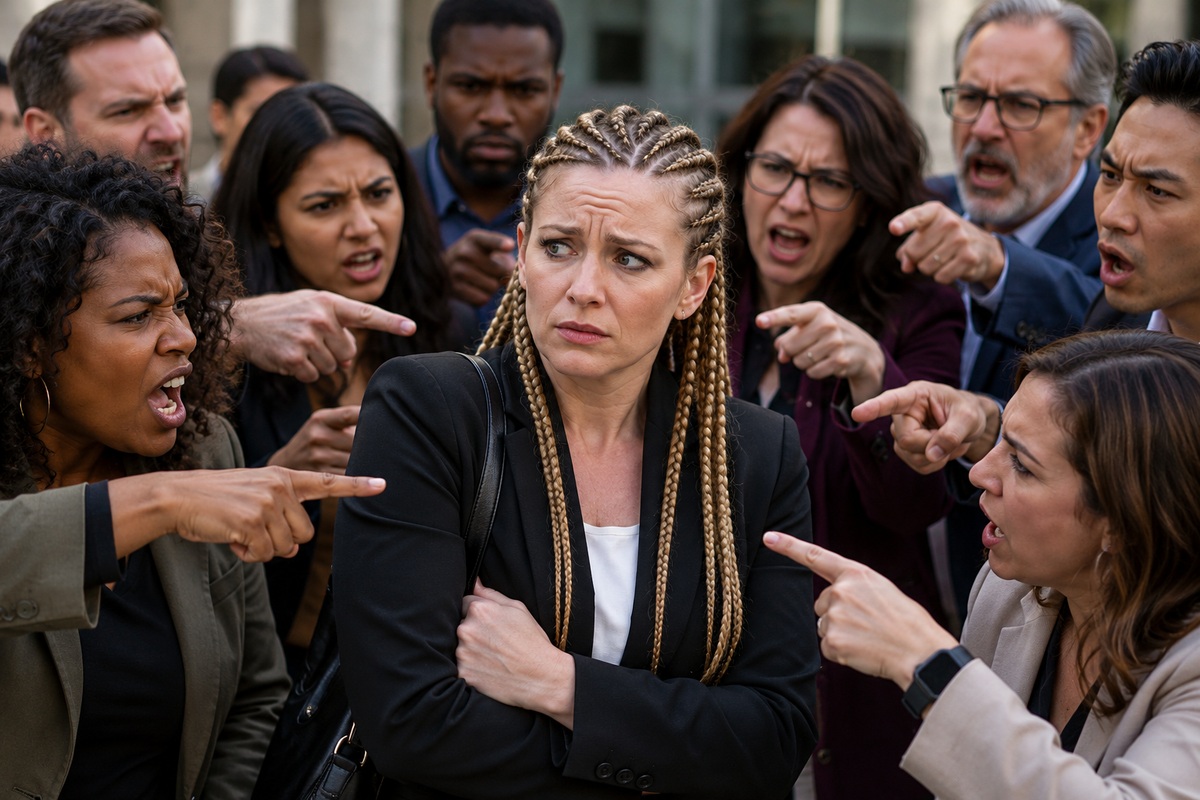
Consider Kelly Carnes, a white woman hired in September as executive director of the Baltimore Rock Opera Society.
Carnes attended the Burning Man festival in Nevada, where she wore cornrows to protect her hair from the desert’s dust and wind.
Some members of the organization’s community lost their minds, characterizing the hairstyle as “cultural appropriation.” For those of you who do not know what that means, I will explain. Kelly Carnes, a white woman, was deemed to be a hater of black women. Why? Because she adopted a hairstyle that is common among black women. (White women who adopt cultural styles of black women obviously hate black women. Get it? If I eat tacos, clearly I am high jacking a cultural cuisine of Mexicans, whom I undoubtedly hate by such adoption. Now do you get it? Embracing an element from a culture other than your own means you hate that culture and its people.)
Within weeks of starting her new job, Carnes was fired.
The organization reportedly told her that she wasn’t a good fit. Had she wanted to be a “good fit,” she would have stayed in her lane with regards to her hair style.
Now, whatever one may think about this notion of cultural appropriation, surely wearing a hairstyle associated with another culture shouldn’t become grounds for questioning someone’s character or professional suitability.
Human cultures have borrowed from one another for thousands of years. Music, cuisine, language, fashion, and art have all been enriched through cultural exchange. If, when saying farewell to a friend, I say “ciao,” does that point to a hatred I have towards Italians? To many of the Left, that is precisely what it means. And yet it is predominantly the Left that barks about the importance of inclusion with stunning regularity. Does anyone see a disconnect?
And further, where does appreciation end and appropriation begin? And who gets to decide? Even more to the point, how does a white woman wearing cornrows rob a black woman from wearing them?
Even Bill Maher Is Raising the Alarm
Liberal comedian Bill Maher has repeatedly criticized what he regards as ideological excesses within his own political camp.
Maher remains a vocal critic of Donald Trump and the Republican Party. Yet he has also challenged fellow liberals over political correctness, intolerance, and what he sees as the Democratic Party’s reluctance to confront its more radical activists.
His willingness to criticize his own side is instructive.
None of these incidents establishes that every single person on the Left thinks alike. They certainly don’t. Nor is intolerance exclusively a phenomenon of the Left.
But these episodes raise questions that deserve answers.
When does sensitivity become excessive suspicion? When does the pursuit of racial justice become selective hostility? And when does celebrating diversity turn into policing how other people dress, speak, or what they eat, or how they wear their hair?
Perhaps the greatest danger facing any political movement is becoming so convinced of its own moral righteousness that it stops examining its own contradictions.
And that, my friends, is the latest elephant in the room.





Get cutting-edge tips, resources, and perspectives: