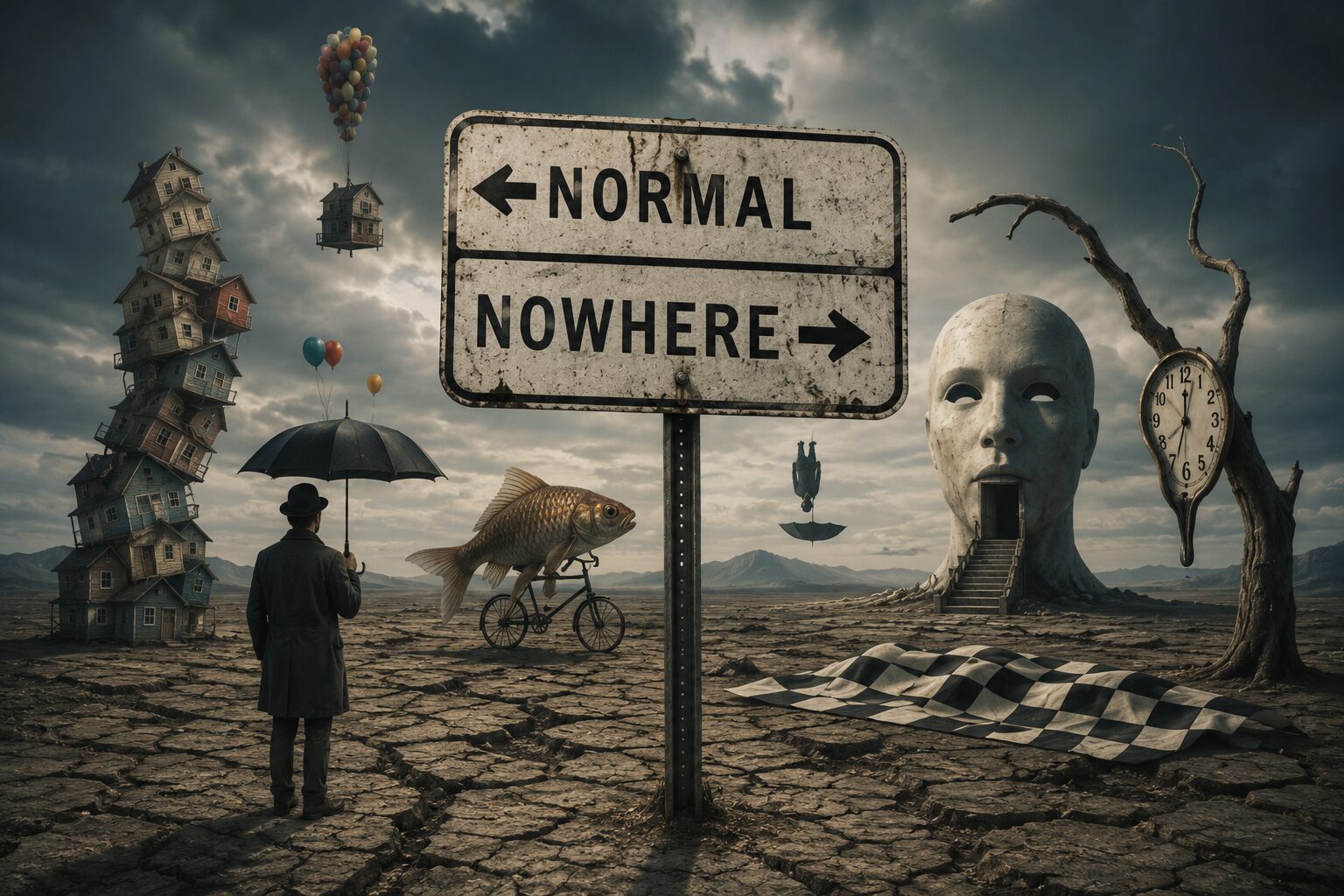
I have spent a good deal of time over the years criticizing Leftism, not because I enjoy political combat for its own sake, but because I believe the modern Left increasingly finds itself at odds with many of the values that have historically allowed Western civilization to flourish.
Before proceeding, let me define what I mean by normalcy. I do not mean perfection. Human beings are imperfect, and every society has its flaws. By normalcy, I mean those broadly shared values and social norms that have traditionally enabled families, communities, businesses, and nations to function: personal responsibility, stable families, faith, patriotism, self-reliance, merit, entrepreneurship, and basic civility.
The concern is that many of our most influential institutions no longer celebrate these things. Instead, they often appear determined to elevate ideological causes that would have been considered fringe only a generation ago.
Consider Father’s Day.
One might reasonably expect a major newspaper to use Father’s Day as an opportunity to celebrate fatherhood itself—to highlight the sacrifices fathers make, the lessons they teach, and the indispensable role they play in the lives of their children. Yet the New York Times chose instead to publish a guest essay by a transgender activist – a woman who pretends she is a man – giving advice about “trans-fatherhood.”
Whether one agrees or disagrees with transgender ideology is not really the point. The point is that even on Father’s Day, many elite institutions seem unable to simply celebrate fatherhood. Every occasion must become an opportunity to advance a cultural or political narrative.
The institution (in this case, the New York Times) reveals its priorities through its choices.
Or consider the recent appearance of Vice President J.D. Vance on The View. Joy Behar, who is seldom accused of harboring conservative sympathies, treated the Vice President with a degree of courtesy. In a healthier political culture, that would not be noteworthy. It would simply be called good manners.
Instead, some of her co-hosts reacted as though civility itself were suspect. The implication was that extending respect to a political opponent somehow constituted a form of betrayal.
Yet treating people with courtesy—even those with whom we disagree—is one of the foundations of civilized discourse. The fact that this now seems controversial tells us something about the current state of our political culture.
The same pattern appears elsewhere.
Professional sports once focused primarily on sports. Today, many activists insist that every major institution must become a vehicle for social messaging. Major League Baseball has increasingly embraced Pride Month promotions, and players who object often find themselves under intense pressure. Yet when athletes express traditional religious beliefs, the reaction is frequently quite different.
The message increasingly appears to be that some forms of expression are celebrated while others are merely tolerated—or discouraged altogether. Traditional religious viewpoints are often treated as awkward relics, while progressive social causes are treated as mandatory civic virtues. Once again, what was once considered normal becomes controversial, while what was once controversial becomes institutionalized.
Finally, consider the now-common practice of “land acknowledgements.”
At the opening ceremony for the Obama Presidential Center, Valerie Jarrett, who was functioning as MC at the event, paused to acknowledge the various Native American tribes that once inhabited the land upon which the center was built.
Such rituals have become commonplace in progressive circles. But they often raise an obvious question. If the land truly belongs to someone else, why not return it? Why construct a multimillion-dollar facility on the property while simultaneously expressing symbolic regret for occupying it?
As Beth Anne Mumford of Americans for Prosperity observed, land acknowledgements often amount to saying, “I care deeply about this issue—but not deeply enough to do anything about it.”
In that sense, the ritual seems less about justice than about signaling virtue.
The larger issue is not any single example. It is the pattern.
Across media, academia, entertainment, corporate America, and politics, we increasingly see institutions treating traditional American values as something to be questioned, apologized for, or replaced. Meanwhile, causes and ideologies that once occupied the margins are elevated to positions of cultural prestige.
The debate before us is therefore not merely political. It is cultural. It is a debate over what kind of society we wish to preserve and what kind of society we wish to become.
One side still believes there is wisdom in the traditions, institutions, and values that built this country. The other seems increasingly convinced that those traditions must be dismantled, redefined, or discarded.
That tension lies at the heart of many of our cultural battles today.
And that, my friends, is the latest elephant in the room.





Get cutting-edge tips, resources, and perspectives: