
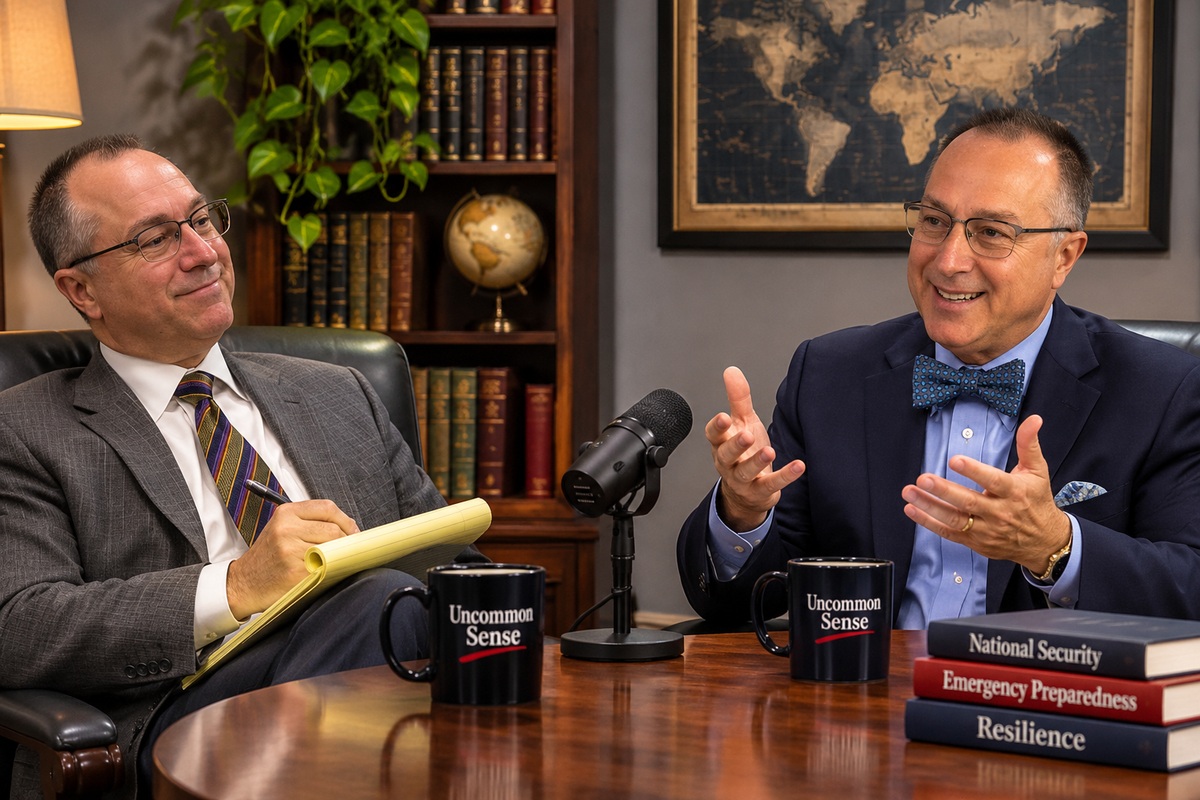
Today, I’m going to do something a little different. I’m going to conduct an interview. With whom, you ask? With myself! After all, who better to ask the questions I want answered?
Q: What do you make of all the commotion surrounding national security and emergency preparedness these days?
A: Two things are happening simultaneously. First, people are becoming increasingly anxious about the possibility of a national catastrophe. Second, in true capitalistic fashion, entrepreneurs are capitalizing on that anxiety. The result? Fear is becoming a very profitable commodity.
Q: What, precisely, has everyone so worked up?
A: There have been alarming claims circulating about American military personnel supposedly being recalled to the United States and sheltered in underground bunkers, where they’ll have access to food, water, electricity, and other necessities. The implication is that our government knows something the rest of us don’t—perhaps that an electromagnetic pulse (EMP) attack is imminent.
Such an attack could potentially disable large portions of our electrical infrastructure, disrupt communications, interfere with water distribution, and bring much of modern society to a standstill.
But here’s the important distinction: Just because something could happen doesn’t mean it’s about to happen. I’ve seen no credible evidence establishing that these particular rumors are true, but note that the fact that I myself have not seen credible evidence in no way suggests that these are nothing more than unfounded rumors. After all, I also saw no credible evidence that the 9/11 attacks by radicalized Islamicists were going to take place either.
Q: So you think it’s all nonsense?
A: Not at all. The threats themselves deserve serious consideration. What I question is the certainty with which some people predict an impending catastrophe.
History is filled with events that caught people completely off guard. Think Pearl Harbor. Think September 11, 2001. Think COVID-19. And consider the possibility of cyberattacks, terrorist attacks, natural disasters, or disruptions to our nation’s electrical grid.
The world is not populated exclusively by people who wish America well. There are hostile governments and terrorist organizations that would gladly inflict tremendous suffering upon us if they had the means and opportunity.
But acknowledging genuine threats is very different from surrendering to fear.
Q: What about Iran? Isn’t that a legitimate national security concern?
A: Absolutely. Iran’s revolutionary leadership has a long history of hostility toward the United States and Israel, and its religious ideology includes a glorification of martyrdom that Western observers should not casually dismiss.
But we should also recognize that ideological fanaticism and strategic calculation can coexist. Iran’s leaders have repeatedly demonstrated an interest in preserving their regime. That doesn’t eliminate the danger, but it does mean we shouldn’t automatically assume they would welcome their own annihilation (although, admittedly, the most radicalized among their radicals may well be populated by people are do value death over life – including their own death.)
Now, President Trump has demonstrated a willingness to employ military force against Iranian targets. He’s done it before and he may well do it again. But whether that deterrence will be sufficient is another question entirely.
Q: What about threats here at home?
A: Great question. National security isn’t exclusively about foreign adversaries. It’s also about maintaining the capabilities necessary to protect American citizens from internal threats. Think of the Left-wing terror group that calls themselves Antifa, which is ironic since they claim to be anti-fascist while behaving like fascists themselves.
Or consider New York City, where Mayor Zohran Mamdani announced the disbanding of the NYPD’s Strategic Response Group on November 16. Established in 2015, this specialized unit had responsibilities involving counterterrorism, rapid response, and crowd management.
Now, to be fair, its counterterrorism responsibilities are being transferred to the NYPD’s Intelligence and Counterterrorism Bureau, and its officers are being reassigned. The administration argues that the reorganization will improve policing. Critics, including police union representatives, have expressed concerns about the consequences.
I believe such reorganizations deserve careful scrutiny. Changing the structure of a police department is one thing. Ensuring that its critical public-safety capabilities remain effective is quite another.
Q: Meanwhile, what are businesses doing with all this anxiety?
A: They’re having a field day!
We’re being bombarded with advertisements for emergency sleeping bags that supposedly prevent us from freezing to death, special filtration straws that allow us to drink from muddy streams, emergency sanitation kits for when our toilets stop flushing, survival food guaranteed to last for decades, portable power stations, and just about every conceivable gadget marketed as the difference between life and death.
Some of these products are genuinely useful. Others are overpriced, overhyped, or simply unnecessary. And sometimes what arrives at your doorstep bears little resemblance to the miraculous product depicted in the advertisement. Case in point: the sleeping bags I mentioned. I ordered ten of them to give away as gifts. Yet they look nothing like the sleeping bags displayed in their advertisements. I attempted to sleep with one just the other night. A very disappointing experience. I’m returning all of them.
And for what it’s worth, here’s a question worth asking before purchasing any such products: Would I still consider this a wise purchase if the latest frightening prediction turned out to be completely false?
If the answer is yes, perhaps you’re making a prudent investment. If the answer is no, you may simply be allowing someone else’s marketing campaign to dictate your decisions.
Q: So what’s your advice? Should people prepare for emergencies or simply ignore the warnings?
A: Prepare! Absolutely, unequivocally, prepare!
I belong to a faith community that has long emphasized a simple principle: “If ye are prepared ye shall not fear.”
And I believe that principle applies far beyond religion.
For starters, I recommend that every household work toward maintaining at least a three-month supply of drinking water. That’s more ambitious than the minimum recommended by most emergency-management agencies, but I believe it’s a sound long-term objective.
And before someone tells me that’s impractical, consider this: I live in a townhome that’s not what one would call palatial, and I’ve made room for a substantial supply of various types of water – canned and bottled, flat and sparkling, flavored and unflavored. If I can find the space, many families living in larger residences can certainly do likewise. It’s largely a matter of priorities.
Q: Is water enough?
A: Of course, water is only the beginning.
I recommend individuals and families build a supply of nonperishable food that you actually eat, and rotate it regularly. Keep flashlights, batteries, first-aid supplies, necessary medications, and some cash in small denominations on hand. Consider alternative cooking arrangements and a means of maintaining communications during an emergency.
Should you purchase a generator? Perhaps, depending on your circumstances. Just remember that generators must be operated outdoors, well away from windows and doors, to avoid deadly carbon monoxide poisoning.
What about an additional freezer? That can be useful for ordinary food storage, but remember that a freezer full of food won’t do you much good during an extended power outage unless you have a reliable backup power source.
Q: And what about protecting your family and property? Any thoughts on that?
A: That’s another legitimate consideration, although any defensive equipment should be accompanied by appropriate training, secure storage, and a clear understanding of the law.
The point is not to purchase everything imaginable. It’s to establish priorities and gradually build a sensible reserve of essential supplies.
And for heaven’s sake, don’t go broke trying to prepare for a financial or societal catastrophe that may never occur!
Q: So then, how much preparation is enough?
A: There is no one right answer. That’s a question every household must answer according to its circumstances, resources, and vulnerabilities.
Start with the essentials. Build toward a few weeks of supplies. Then, as finances and storage space permit, extend your reserves. My own preference is to think in terms of months rather than days, especially when it comes to water and food.
And keep in mind that preparedness isn’t an event! It’s not a one and done. It’s an ongoing habit.
Q: Any final advice?
A: Yes. Above all, don’t panic.
Fear has a way of short-circuiting rational thinking. When people become frightened, they often make impulsive purchases, accept dubious claims, and surrender their judgment to whoever sounds the most alarming.
Remember what happened during the COVID-19 pandemic? Suddenly, toilet paper became a commodity almost as precious as gold! Store shelves were stripped bare, and people scrambled to purchase everyday necessities they had previously taken for granted.
But those who already had adequate supplies didn’t need to participate in the madness. They could simply carry on.
That’s the beauty of preparedness.
You don’t have to predict the next catastrophe. You don’t have to know whether the next emergency will involve a hurricane, an earthquake, a cyberattack, a pandemic, or an extended power outage.
You simply need to take reasonable steps today so that, should something happen tomorrow, you and your loved ones aren’t helpless.
So buy what you need. Store what you can. Learn what you don’t know. Make preparation a normal part of your everyday life.
And remember: There’s a world of difference between being prepared for the worst and spending your life expecting it.
Q: I have to say this was a very engaging and informative interview.
A: I couldn’t agree more.
And that, my friends, is the latest elephant in the room.





Get cutting-edge tips, resources, and perspectives: